
1.1 ACICA 1/3/06 Response to the Home Office consultation paper
Rebuilding Lives - Support for Victims of Crime
1.2 ACICA's 29/3/04 Response to the Home Office consultation paper
Compensation and Support for Victims of Crime
1.1 ACICA 1/3/06 Response to the Home Office consultation paper
Rebuilding Lives - Support for Victims of Crime
Download the response as a PDF file (172kb)
PDF assistance
Free Adobe Acrobat PDF reader software and general help with PDFs, is available from this link- http://access.adobe.com (this will open a new window).
1. “ACICA” is a specialist company assisting the victims of crime (including terrorism) in Great Britain obtain compensation, principally under the current Criminal Injuries Compensation Scheme (CICS). “ACICA” was founded in 2000 (by Richard Dobson, a chartered insurer, and Chris Smith chartered accountant and has advised and assisted thousands of potential/actual applicants with their claims including advocacy and representation at hearings when appropriate.
2. We are not attempting to address all the ideas proposals and recommendations raised or made in the consultation paper but concentrate on those that directly impact on the financial support offered to the victims of crime (i.e. compensation). Italic references are to the responses to the Consultation Questions [page 35] of the consultation paper.
3. Summary
- “Of course they want the money..” Fiona Mactaggart MP Victims Minister 19th February 2006. The most practical form of support that a victim of a crime of violence can receive is compensation.
- A long term view of Criminal Injury Compensation should be taken by governments. The majority of victims have been eligible for compensation since the mid 1960's. At a time of increased risks of terrorist attacks and security concerns it is ridiculous to eliminate the majority of victims (of both crime and terrorism) from eligibility for compensation.
- Including their families and partners over one million people's lives would be seriously affected if the proposed change had been introduced in 1997. Belief in the Criminal Justice system, at a time when victim confidence in the system is already very low, would be adversely impacted amongst this huge group of people.
- The level of all CICS awards for pain and suffering, including fatalities and other losses and costs, should be reviewed annually by Government rather than partially once in 10 years.
- “Course of duty” or employment compensation changes should take place only when equivalent arrangements for all individuals (both employed and self employed) are available and in place.
- Financial recoveries from offenders, and their sponsoring organisations where applicable, should be sought and facilitated by Government.
4. The focus of the Scheme [3)a)]
4.1 Supporting Victims of Crime [3)a)]
All victims of crime lose. Security, self respect, family members, friends, employment, physical and mental attributes and abilities, earnings, earnings capacity, care, attention, possessions and many, many other losses. Compensating for, or replacing these requires resource as does the recovery process itself.
THE MOST PRACTICAL FORM OF SUPPORT IS FINANCIAL COMPENSATION.
ALL ie 100% of the people we have assisted need, want and use the compensation in an attempt to recover from their individual losses.
IN ASSESSING THE RESPONDENTS TO THIS CONSULTATION PAPER THE NUMBER OF INDIVIDUAL VICTIMS WHO HAVE RECEIVED CRIMINAL INJURIES COMPENSATION MUST BE HIGHLIGHTED. THEIR VIEWS MUST BE GIVEN APPROPRIATE WEIGHTING OVER OTHER ORGANISATIONS, ASSOCIATIONS, EMPLOYERS, ACADEMICS AND GOVERNMENT DEPARTMENTS AND PUBLIC AGENCIES WITH REGARDS, IN PARTICULAR, TO THE GOVERNMENT'S REFOCUSSING PROPOSALS.
In the last consultation on the Scheme (Compensation and Support for Victims of Crime) 29 of the 106 respondents were individuals.
4.2 A Longer term view [3)a)]
4.2.1History [3)a)]
The first Scheme was set up in 1964 with compensation being calculated in the same way as common law damages. This concept of comparability has, by and large, been retained under the tariff scheme introduced in 1996 with all injuries above a practical (and defined) minimum level, being eligible for compensation under the Scheme.
With effect from 1st January 2006 in accordance with European Union Council Directive 2004/80/EC all EU member states (25) are required to have compensation schemes which guarantee fair and appropriate compensation to victims of violent crime.
Certain of the major EU countries have schemes, which compensate nationals for terrorist injuries inflicted outside their borders.
4.2.2Terrorist incidents & homicides [3)a)]
Victimisation levels change through time and major policy changes (like the currently proposed ones) have previously occurred in 1964 and 1996 as far as Great Britain is concerned and in 2006 with regards to the EU.
A comparison of crime (recorded homicides) over a significant time perspective incorporating terrorist incidents/bombings is given below
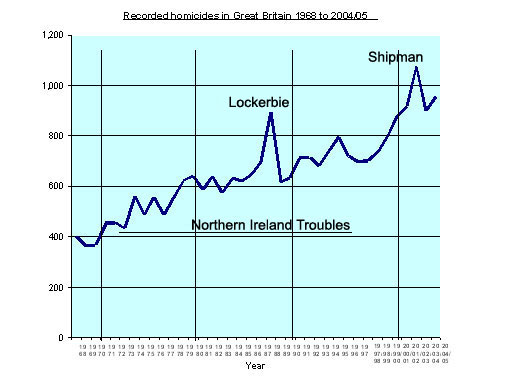
Details of the basis of the underlying data is provided in Annex 1.
Many of the multiple homicides also involve significant numbers of injured victims e.g. over 700 victims were injured in the London bombings on 7th July 2005.
In considering criminal injury compensation a longer term view covering 15 to 25 years should be adopted by Governments, preferably with cross party agreement. Short term decisions based on a recent incident cannot be in the interests of either the publics' security or the Criminal Justice System.
Whilst hypothecation of any taxes is unattractive, if such all party agreement could be reached for a Terrorism & Crime surcharge on say, both employers and employees national insurance, revised funding and administrative arrangements for the Scheme could be investigated.
4.3 Eliminating Victims from the Scheme [3)a)]
The tariff Scheme compensation awards by bands 1-10 £1,000 to £5,000/£5,500 (the award levels - bands 7 to 21 were increased by 10% for applications made after 1st April 2001) and 11-25 £6,000/£6,600 to £250,000 since 1997 are shown in the following table. The information has been extracted from the published annual report and accounts of the Criminal Injuries Compensation Authority (CICA) until 2002/03 and thereafter estimated in the absence of their publication.
No restatement has been made to reflect changes in the CICA's reporting practices over the years.No awards are included relating to the 1990 common law scheme which operated until 31st March 1996.
Awards by Bands |
TOTAL 1997 to 2006 | 05/06 #‘000E |
04/05 #‘000E |
03/04 #‘000E |
02/03 # ‘000 |
01/02 # ‘000 |
00/01 # ‘000 |
99/00 # ‘000 |
98/99 # ‘000 |
97/98 # ‘000 |
|
‘000 |
% |
||||||||||
1 to 10 |
308.3 |
89.9% |
33.8 |
33.7 |
33.7 |
37.5 |
35.5 |
33.0 |
35.7 |
36.5 |
28.9 |
11 to 25 |
34.6 |
10.1% |
3.7 |
3.8 |
3.8 |
4.8 |
4.3 |
3.9 |
4.0 |
3.7 |
2.6 |
Total |
342.9 |
100% |
37.5 |
37.5 |
37.5 |
42.3 |
39.8 |
36.9 |
39.7 |
40.2 |
31.5 |
Awards of £500,000 |
# |
# |
# |
# |
|||||||
# NOT '000 |
N/A |
N/A |
N/A |
N/A |
N/A |
4 |
1 |
N/A |
N/A |
1 |
0 |
N/A = Not available E = estimated
From the above table over 300,000 awards have been made since 1997 in bands 1 to 10, which by implication the Government is proposing scrapping.
Allowing for friends families and partners the people impacted by such a decision would likely be in excess of one million.
Per the British Crime Survey for 2004/05 the percentage that is very, or fairly confident that the Criminal Justice System meets the needs of the victims of crimes stands at only 34%.
The proposal to eliminate any, let alone 90% of victims, from the scheme will reduce this low confidence level even further.
5. Award levels under the Scheme [2)a, 3)a), 4)a) & b)]
ALL (i.e. tariff awards, including fatality, loss of parental services and the maximums payable on loss of earnings and in respect of the same injury) should be regularly reviewed likely on an annual basis reflecting increases, by and large, in line with those awarded by the civil courts.
The current Scheme award levels have been partially reviewed once in 2001 by the then Home Secretary Jack Straw as detailed in 4.3 above. The top four bands were not increased at that time. This is the only occasion, since 1996 when the tariff Scheme was introduced, that the levels have been increased.
The Retail Price Index has increased by just under 27% since the introduction of the tariff Scheme in April 1996. The maximum award level of £500,000 from published data appears to be reached on average on two occasions per year.
Separate awards for lost earnings and care costs should continue. Personal injury damage principals should be retained for special and general damages.
6. Implementation of major changes to the Scheme [5)a)]
Where major changes to the Scheme are made realistic transition arrangements should apply.
Currently applicants are required to make a claim within two years of the incident occuring. (Three years is the time period applicable to personal injury cases pursued through the civil courts).
Any major changes to the Scheme should incorporate an option for all applicants to be considered under the Scheme of their choice exercisable within two years of the date of the incident. This option would continue to exist for a maximum period of two years from the date of change of the Scheme.This option should apply to both existing and new applicants.
7. “Course of duty” / employment changes [8)a) & b)]
The previous review of the Scheme (March 2004) encountered strong opposition from both the private and public sectors to any changes in the responsibility for “Course of duty” / employment compensation.
No changes should be implemented unless and until robust enforceable arrangements exist for the compensation of all employed and self employed individuals both in the public and private sectors.
Case by case basis consideration is likely inappropriate, in that people can have differing status in the same incident being killed or injured whilst on duty / employment or not. E.g. in the London bombings some of the victims will have been travelling in the course of their employment whilst others will simply have been using the tube/bus for their own personal reasons un-associated with employment.
At a time of increased risk of terrorist attacks it does seem inappropriate that a majority of the emergency services, on whom the public and Government rely in such situations are having their rights to eligibility for compensation removed.
8. Applicant's criminal record [7)a)]
Revised arrangements should only be introduced on legislative change to the Rehabillitation of Offenders ACT 1974 being implemented. Revised rules should then be drawn up after wide consultation with approriate organisations such as NACRO.
9. Speed of making, decisions, payments and interim awards [6)a)]
The effective delivery of an adequately resourced public service should take account of the needs of the group it serves, including speed of resolution and necessary measures to assist the group pending resolution.
Appropriate resources in both systems and headcount terms in conjunction with other public services agreements and cooperation, could lead to dramatically improved case resolution timescales.
In 2002/03 (the last published accounts of the authority) the percentage of decisions made within a 12 month period (of their receipt) was 76.01% (2001/02 77.47%). Recently disclosed information shows that “the median average elapsed time from the date of receipt of an application to the date of first offer was 248 days in 2004 and 291 days in 2005”.
A large proportion of the information required under the Scheme by the Authority (CICA) to resolve cases comes from the public sector i.e. mainly the police forces, Courts, Crown Prosecution Service, NHS, DWP and the Customs & Revenue. There are many ”backlogs”, some of many months, in these organisations regarding the processing of CICA requests for information. The Government's expertise (possibly in conjunction with their funding arrangements) of service improvements in these organisations could radically improve the situation as far as victims are concerned.
Interim awards should be more widely used and some of the current practices reviewed e.g. the length of time from receipt of a case before an interim award is offered and the proportion of the likely award that applies.
10. Recoveries from offenders [1)a)]
Affordable Court compensation if ordered should be paid. Its non payment reduces confidence in the Criminal Justice System.
As a principal Government and its agencies should pursue, and facilitate the receipt of, compensation from offenders, and their sponsoring organisations where appropriate, including the attachment/confiscation of their estates, assets funds etc. for the benefit of victims.
The Lockerbie victims' families received $8m US each although not until 15 years after the disaster occurred.
Annex 1
Recorded homicides 1 in Great Britain 2 1968 to 2004/05
1968 |
404 |
1983 |
577 |
3 |
1997/98 |
705 |
||||
1969 |
365 |
1984 |
632 |
3 |
1998/99 |
740 |
||||
1970 |
368 |
1985 |
621 |
1999/00 |
797 |
6 |
||||
1971 |
454 |
1986 |
648 |
2000/01 |
879 |
|||||
1972 |
458 |
3 |
1987 |
698 |
2001/02 |
917 |
||||
1973 |
434 |
3 |
1988 |
898 |
3,4 |
2002/03 |
1,078 |
7 |
||
1974 |
564 |
3 |
1989 |
618 |
3 |
2003/04 |
901 |
|||
1975 |
489 |
3 |
1990 |
635 |
3 |
2004/05 |
957 |
|||
1976 |
559 |
3 |
1991 |
712 |
3 |
2005/06 |
8 |
|||
1977 |
487 |
1992 |
717 |
3 |
|
|||||
1978 |
550 |
1993 |
681 |
3 |
||||||
1979 |
623 |
3 |
1994 |
743 |
||||||
1980 |
641 |
1995 |
796 |
|||||||
1981 |
589 |
3 |
1996 |
719 |
3,5 |
|||||
1982 |
639 |
3 |
1997 |
699 |
||||||
1 Includes the offences of murder manslaughter and infanticide as currently recorded by the police.
2 The data source is - for England and Wales, Home Office Statistical Bulletin, Violent Crime Overview, Homicide and Gun Crime 2004/05 Table 2.01 - for Scotland as provided by the Justice Statistics Unit of the Scottish Executive Justice Department.
3 Between 1972 and 1996 125 deaths have been associated with the Northern Ireland troubles. 46 occurred in 1974 (12 in the Yorkshire army coach bombing, and 21 in the Birmingham pub bombings).11 occurred in both 1982 (Hyde Park cavalry and bandsmen bombings) and 1989 (Kent Barracks bombing in Deal).
4 Includes 270 deaths in the Lockerbie disaster.
5 Includes 17 deaths in the Dunblane tragedy.
6 Includes 3 deaths in the Admiral Duncan pub nail bombing in Soho.
7 Includes 172 victims (of the total of 215) of Dr Harold Shipman recorded by the Greater Manchester Police as murders in 2002/03. His victims were killed between 1975 and 1998.
8 Will include 52 victims of the London terrorist bombings on 7th July 2005.
Every homicide is a tragedy to a great number of people and the above table, the graph in the report and any annotations are not intended to cause offence in any way to any of them by either inclusion or omission.